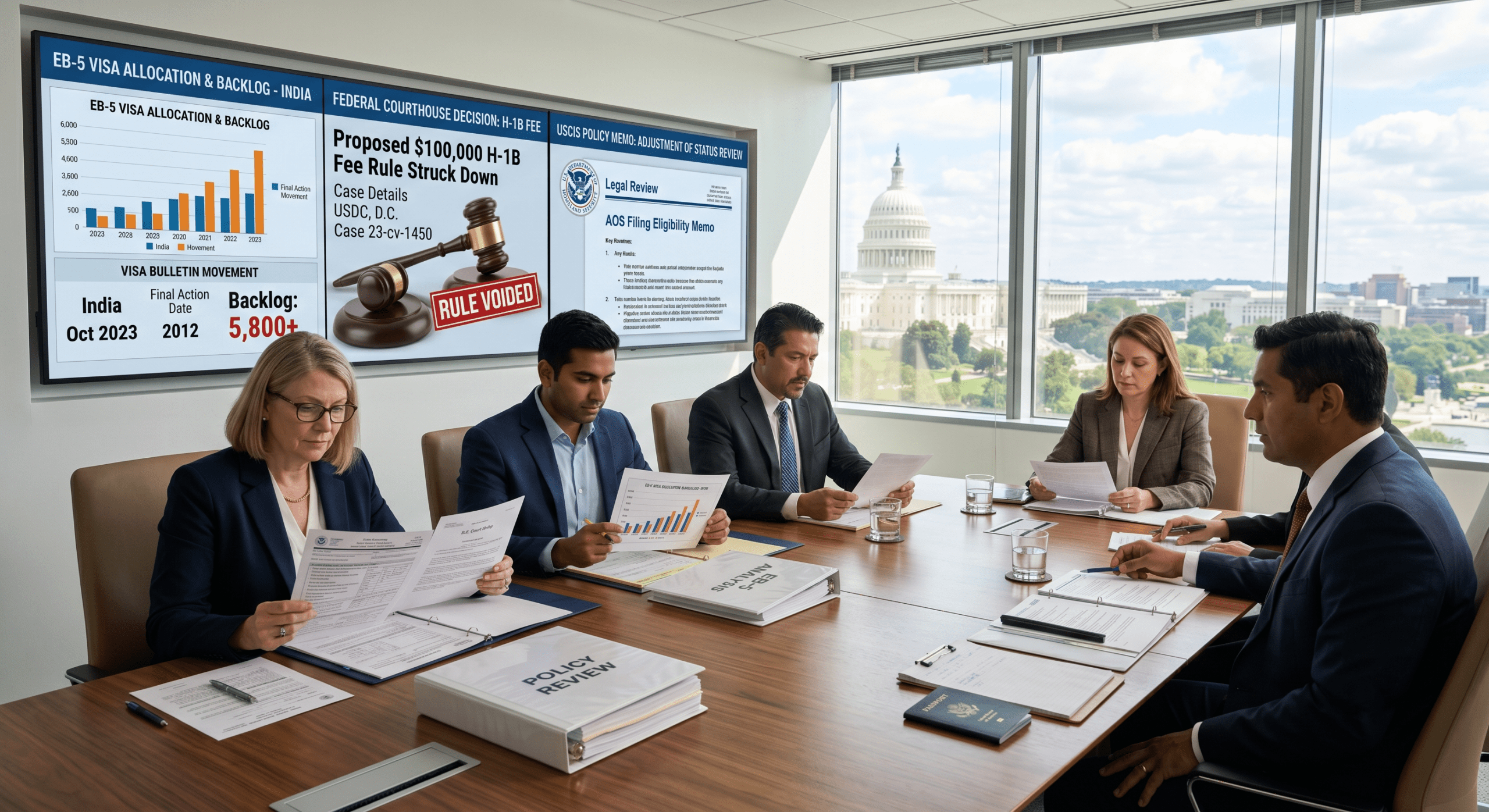
Several significant immigration developments have emerged in recent weeks that may have implications for current and prospective EB-5 investors. These include the reporting that India has exhausted its Fiscal Year 2026 allocation of unreserved EB-5 visas, a federal court ruling striking down the controversial $100,000 H-1B visa fee, and ongoing litigation and industry opposition surrounding a recent USCIS policy memorandum that seeks to restrict adjustment of status processing.
India Appears to Have Exhausted Its FY 2026 Reserved EB-5 Visa Allocation
One of the most significant developments for Indian EB-5 investors is the apparent exhaustion of available unreserved EB-5 visa numbers for Fiscal Year 2026. Due to strong demand from India, the Department of State has indicated that the annual supply of unreserved EB-5 visas has been fully allocated, resulting in a cutoff date and the creation of a growing backlog for investors filing in the traditional EB-5 category.
Importantly, this development does not currently affect the reserved visa categories created by the EB-5 Reform and Integrity Act of 2022 (RIA). Rural, High Unemployment Area (HUA), and Infrastructure set-aside categories remain current for Indian investors at this time. India is close to clearing its backlog of unreserved visas stemming from pre-RIA cases, but that will have to wait a little it longer as new unreserved visas for Indian investors will come online on October 1st, with the start of FY 2027.
Federal Judge Invalidates the $100,000 H-1B Fee
Another major immigration development occurred when a federal judge in Massachusetts invalidated the Trump Administration’s controversial $100,000 H-1B visa fee. The fee, which was implemented through a presidential proclamation in 2025, dramatically increased the cost of sponsoring certain foreign workers and generated widespread concern among employers, universities, and immigration advocates.
U.S. District Judge Leo Sorokin ruled that the fee functioned as a tax rather than a permissible regulatory fee and therefore exceeded the executive branch’s authority because Congress had never authorized such a charge. The court permanently blocked enforcement of the fee and restored the traditional H-1B filing framework. The administration has indicated that it is expected to appeal the decision.
Although the case does not directly involve EB-5, it is another example of federal courts closely scrutinizing executive actions that attempt to alter immigration processes without clear congressional authorization. That principle may become increasingly relevant as other immigration policies face legal challenges in the coming months.
Litigation Continues Over USCIS Adjustment of Status Policy Memorandum
Perhaps the most watched issue for many EB-5 investors is the controversy surrounding USCIS Policy Memorandum PM-602-0199, issued on May 21, 2026. The memorandum significantly reframes adjustment of status (AOS) as an “extraordinary discretionary benefit” and expresses a preference for immigrant visa processing through U.S. consulates abroad rather than allowing eligible applicants to complete the green card process from within the United States.
The memorandum generated substantial concern throughout the immigration community because adjustment of status has long been an established statutory pathway for eligible applicants who are physically present in the United States. Immigration attorneys, trade organizations, and advocacy groups have argued that the policy appears inconsistent with existing immigration statutes and decades of agency practice. Litigation efforts challenging the memorandum are currently developing, and many stakeholders are seeking judicial intervention before the policy can be broadly implemented.
Many industry stakeholders believe that the memo was driven primarily by the administration’s broader efforts to restrict immigration benefits for humanitarian and parole-based populations, particularly asylum seekers, refugees, parolees, and others who entered under programs expanded in recent years. However, the memo was drafted broadly enough that it may also encompass employment-based and family-based applicants.