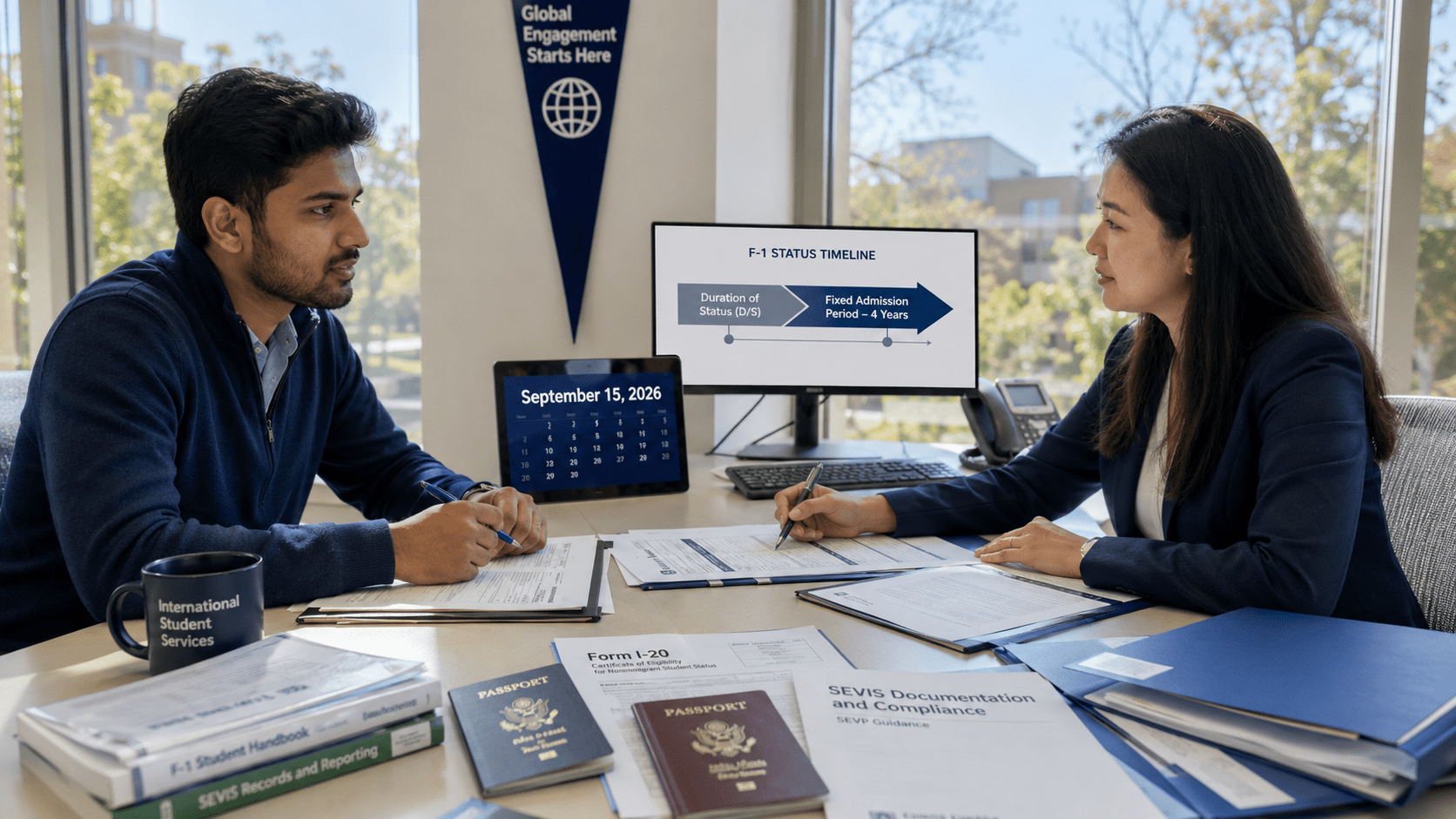
Beginning on September 15, 2026, the Department of Homeland Security (DHS) will fundamentally change how most F-1 student visa holders are admitted to the United States. For decades, F-1 students were generally admitted for “Duration of Status” (D/S), meaning they could remain in the United States for as long as they maintained their student status and complied with the terms of their academic program. Rather than receiving a specific expiration date for their stay, their lawful presence was tied to continued enrollment and compliance with immigration regulations.
Under the new DHS rule, that system largely disappears. Instead, most F-1 students will receive a fixed period of admission of up to four years, even if their academic program extends beyond that period. Students whose programs require additional time must apply to U.S. Citizenship and Immigration Services (USCIS) for an extension of stay before their authorized admission expires. The rule also shortens the post-completion grace period for many students from 60 days to 30 days and places additional restrictions on transfers between schools and changes in educational objectives.
What Changes in Practical Terms?
For many students, the day-to-day experience of attending school will not immediately change. They must still maintain full-time enrollment, comply with employment restrictions, and keep their SEVIS records current.
The difference is what happens over time. Under the previous Duration of Status system, students generally did not need to worry about an expiration date on their period of admission so long as they remained in compliance with their F-1 requirements. Under the new framework, students will now have another immigration deadline to monitor. If additional time is needed to complete a degree program, research project, dissertation, or other academic requirements beyond the authorized admission period, they must proactively obtain an extension from USCIS. Missing that deadline could have serious immigration consequences.
Students pursuing lengthy graduate degrees, Ph.D. programs, or research-intensive programs may be among those most affected because these academic paths frequently extend beyond four years.
Why This Matters for Students Considering EB-5
Although the rule is not directed at the EB-5 Immigrant Investor Program, it has important implications for international students who may eventually pursue permanent residence through EB-5.
One of the major advantages of EB-5 under the Reform and Integrity Act of 2022 (RIA) is that many eligible investors already present in the United States may be able to file an Adjustment of Status application concurrently with their Form I-526E. For F-1 students, this strategy generally depends upon maintaining lawful nonimmigrant status until the Adjustment of Status application is properly filed.
The new DHS rule places greater emphasis on careful immigration planning because there are now additional expiration dates and extension requirements that students must manage. Any lapse in lawful status caused by failing to timely extend an authorized period of stay could complicate future immigration options, including an eventual transition to EB-5.
Earlier Planning May Become More Important
The new fixed-admission system may encourage some international students to begin evaluating their long-term immigration strategy earlier than they previously would have.
Students who know they hope to remain in the United States after graduation may wish to evaluate all available immigration pathways, including employment-based options and EB-5, well before their authorized admission period approaches expiration. Early planning provides time to evaluate investment options, conduct project due diligence, organize source-of-funds documentation, and coordinate filings with experienced immigration counsel.
For students who intend to pursue EB-5, waiting until the last few months of an authorized stay could create unnecessary pressure, particularly if additional documentation or project selection requires more time than anticipated.
Maintaining Status Remains Critical
Perhaps the most important takeaway is that maintaining lawful immigration status remains essential. While the method for tracking status is changing, the underlying requirement has not.
Students should continue to monitor their SEVIS records, maintain full-time enrollment, comply with employment authorization requirements, promptly notify their designated school official of any significant academic changes, and carefully monitor the expiration date of their authorized period of admission. Those who expect their studies to continue beyond their initial admission period should begin discussing extension procedures with their school’s international student office well in advance.
For students who are considering EB-5, maintaining uninterrupted lawful status preserves the greatest number of immigration options and can make a future Adjustment of Status filing significantly more straightforward.
The above article is intended for informational purposes only. Anyone with specific issues related to an F-1 visa or pursuing EB-5 while on an F-1 visa should consult with an experienced immigration attorney.