The H-1B program was in the news for much of 2025 as it faced fundamental changes to how the program is operated. A month into 2026 and H-1B is already back in the news. However, this time the program is facing action from a couple of state governments instead of the Federal oversight it is subject to.
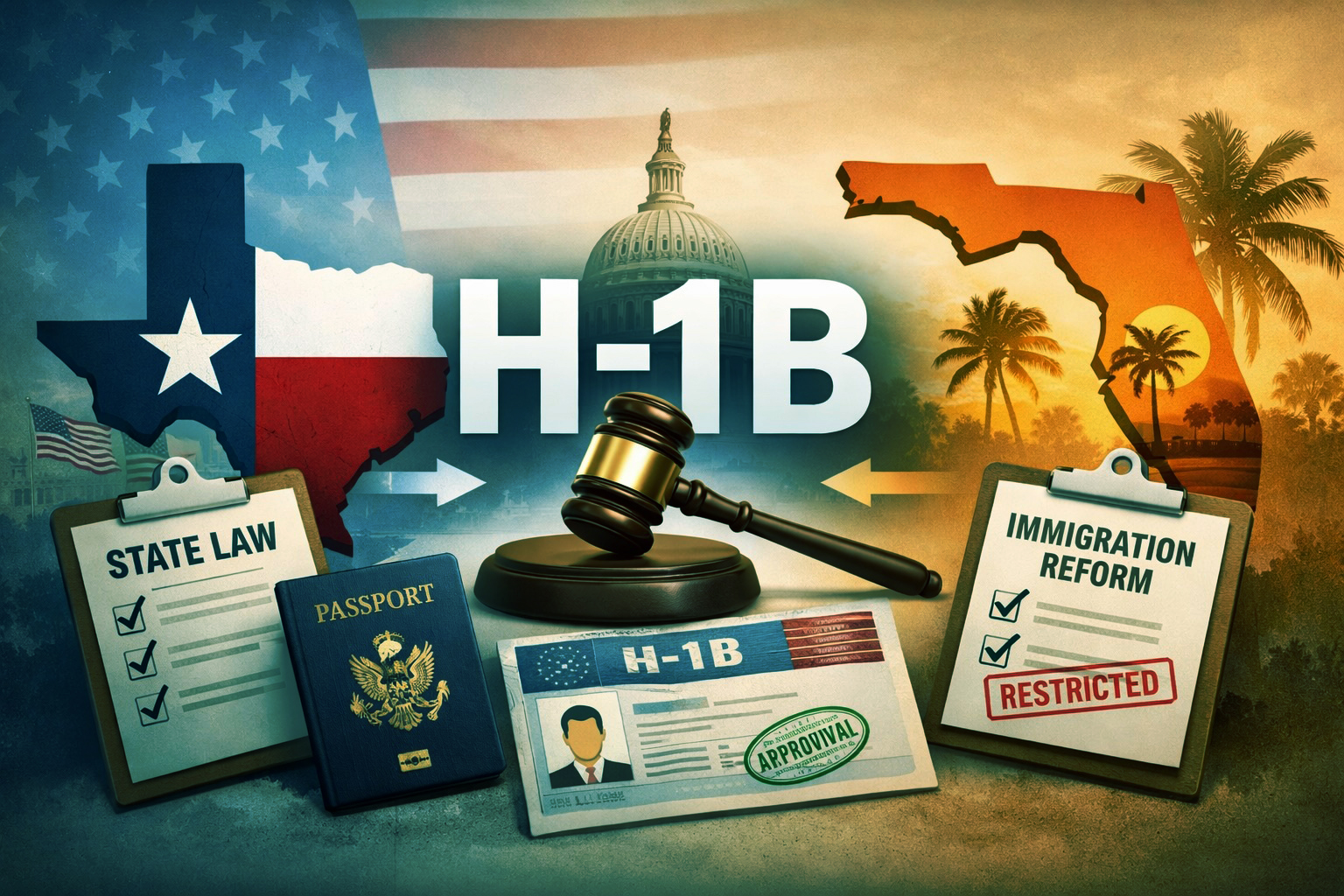
Two states, Texas and Florida, aim to pause or limit state employers from hiring workers on an H-1B visa. While the majority of H-1B workers are employed by private companies, the recent moves are not without impact.
What Texas and Florida Have Done
In late January 2026, Texas Governor Greg Abbott directed state agencies and public universities to pause new H-1B visa petitions, requiring written permission from the Texas Workforce Commission before a state entity can sponsor or hire someone on H-1B. The pause extends through the end of the 2027 legislative session unless lifted.
This move was framed as a “Texans first” policy intended to protect local jobs, but it immediately raised alarms at major public hospitals, research centers, and universities that rely on H-1B talent for clinical care and specialized research. While the order targets state hiring only, the practical effect could be significant for institutions that regularly sponsor physicians, scientists, and academic researchers.
Florida’s public university system moved quickly to consider a similar restriction in which the Board of Governors has proposed a policy that would bar new H-1B hiring by public universities for a set period, following the approach taken in Texas and signaling that multiple states may try to restrict state-sponsored H-1B petitions. Higher-education leaders and faculty organizations in both states have warned that such freezes could harm instruction, research partnerships, and clinical capacity.
What Can States Actually Do?
States can set employment and procurement policies for their own agencies and public institutions, and they can decide that state jobs require U.S. citizenship or permanent residence Additionally, they can direct HR offices not to request federal work-visa sponsorships for new positions. Those internal rules are lawful so long as they do not contradict federal constitutional protections.
What states cannot do, however, is alter the federal immigration system itself as states do not have authority to cancel or rewrite visa categories, adjudicate petitions, or stop private employers from filing H-1B petitions with U.S. Citizenship and Immigration Services (USCIS). A governor’s order or a university board policy can choke off one channel, but it cannot abolish the H-1B program nationally. The likely legal battlegrounds that follow such orders will focus more on administrative procedure, public-policy consequences, and potential conflicts with state law than on rewriting immigration law.
Why EB-5 May Be a Better Alternative
For interested investors and families deciding how to pursue U.S. residency, the EB-5 immigrant investor program offers a fundamentally different model. Instead of relying on an employer’s sponsorship or a temporary nonimmigrant status, EB-5 allows qualifying investors (and their spouses and unmarried children under 21) to apply directly for lawful permanent residence by making a qualifying investment that creates 10 U.S. jobs.
That independence means an EB-5 green card holder is not tied to a particular employer, is not vulnerable to state decisions about H-1B filings, and can live and work anywhere in the U.S. without needing new sponsorship. For professionals worried that government restrictions on H-1B might jeopardize their ability to build a long-term life in the US, EB-5 is an attractive option.
The above article is intended for informational purposes only. Anyone with a specific issue pertaining to H-1B or EB-5 should consult with an experienced immigration attorney.