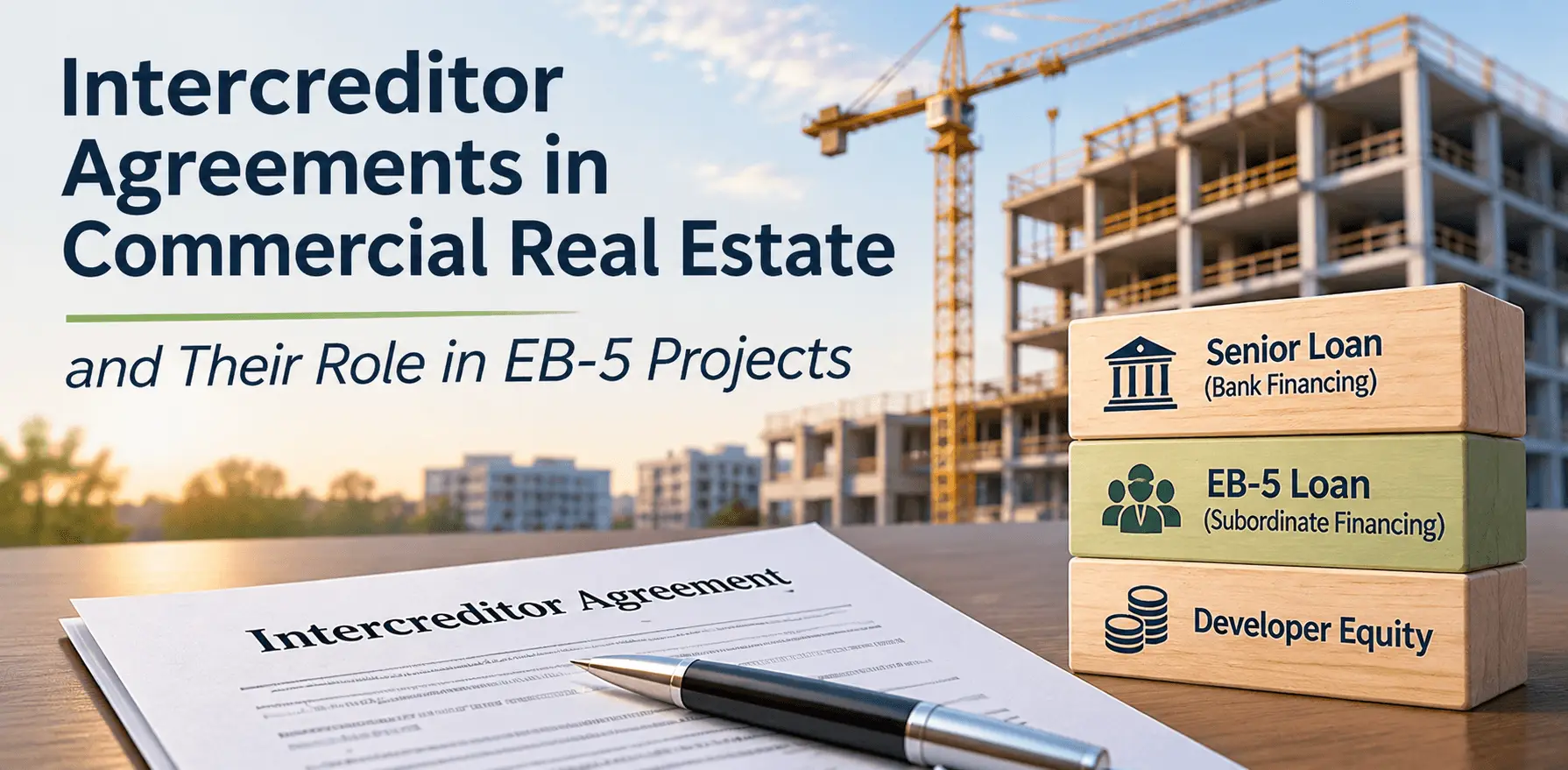
Commercial real estate developments frequently rely on multiple sources of financing to fund construction and initial operations. A project might combine a conventional bank loan, mezzanine financing, developer equity, and EB-5 investment capital. When multiple lenders provide financing to the same project, it is important to establish their respective rights, repayment priorities, and remedies if the project encounters financial difficulties.
One document commonly used to establish these relationships is an intercreditor agreement. These agreements can play an important role in EB-5 projects, particularly when EB-5 capital is structured as subordinate debt alongside conventional senior financing.
What Is an Intercreditor Agreement?
An intercreditor agreement is a legally binding contract between two or more creditors that establishes their respective rights and priorities in connection with a borrower or real estate project. Its primary purpose is to clarify how lenders will interact, particularly when they have competing claims against the same project or collateral.
For example, consider a hotel development financed with a $25 million senior construction loan from a bank and a $15 million subordinate loan from another capital provider. The bank will generally have first priority for repayment and a first-priority lien against the property’s real estate. The subordinate lender agrees to a lower repayment position and may have a second-priority lien or other security interest.
The intercreditor agreement documents this relationship and establishes what happens if the borrower defaults, the property is refinanced or sold, or the senior lender needs to exercise its enforcement rights.
How Senior and Subordinate Financing Work Together
In commercial real estate, senior financing typically represents the primary debt provided to fund a development. Senior lenders generally receive first-priority claims against the project’s collateral and have the first right to repayment from available proceeds.
Subordinate financing occupies a lower position in the capital structure. If a project defaults and the property is sold or foreclosed upon, the senior lender generally receives repayment before the subordinate lender. This means the subordinate lender assumes additional risk because there may not be sufficient proceeds remaining to repay its investment in full.
An intercreditor agreement establishes the rules governing this relationship. Among other things, it typically addresses repayment priorities, restrictions on enforcement, notice and cure rights, and the ability of the senior lender to modify its financing.
One particularly important provision is a standstill provision, which can prevent a subordinate lender from independently pursuing remedies against the borrower or collateral for a specified period following a default. This can limit the subordinate lender’s ability to protect its investment, even when it holds a valid security interest.
How Intercreditor Agreements Apply to EB-5 Projects
Intercreditor agreements are particularly relevant to EB-5 investments structured as loans to commercial real estate developments.
Under the typical EB-5 loan model, investors contribute capital to a new commercial enterprise (NCE), which pools the funds and lends them to a job-creating entity (JCE) responsible for developing or operating the project. The JCE may also obtain financing from a conventional bank or institutional lender.
Consider a hypothetical $50 million hotel development with the following capital structure:
| Financing source | Amount |
| Senior construction loan | $25 million |
| EB-5 loan | $15 million |
| Developer equity | $10 million |
| Total | $50 million |
In this example, the bank provides senior construction financing while the EB-5 NCE provides subordinate financing. The bank may hold a first-priority mortgage against the property, while the EB-5 NCE receives a subordinate security interest or another form of collateral.
Because both lenders have financial claims associated with the project, the bank will generally require an intercreditor or subordination agreement to protect its senior position. This agreement establishes the EB-5 lender’s rights relative to the bank and may restrict when and how the NCE can pursue repayment or enforce its collateral.
Why the Agreement Matters to EB-5 Investors
For EB-5 investors, one of the most important considerations is understanding what rights the NCE actually has if the project encounters financial difficulties.
A project may advertise that EB-5 capital is secured by the underlying real estate or by a pledge of ownership interests in the project. While these arrangements can provide meaningful protections, their practical value depends on the terms of the loan documents and any applicable intercreditor agreement.
For example, an EB-5 NCE might hold a second-priority mortgage against a development. However, if the borrower defaults on its senior construction loan, the intercreditor agreement may prevent the NCE from initiating foreclosure proceedings until the senior lender has exercised its rights or been repaid. Similarly, an agreement may restrict the NCE from enforcing a pledge of ownership interests while senior debt remains outstanding.
This distinction is important: having collateral does not necessarily mean having the unrestricted ability to enforce that collateral. The EB-5 lender’s rights may be subject to significant limitations imposed by the senior lender.
What Should EB-5 Investors Look For?
When evaluating an EB-5 investment, investors should look beyond the stated amount of collateral and understand how the various financing agreements interact. Several provisions deserve particular attention:
- Repayment priority: Is the EB-5 loan subordinate to all senior debt, and what payments can the NCE receive while the senior loan remains outstanding?
- Enforcement rights: Can the NCE take action following a default, or must it wait for the senior lender to exercise its remedies?
- Notice and cure rights: Will the EB-5 lender receive notice of a senior loan default and have an opportunity to cure it?
- Additional senior debt: Can the senior lender increase its loan balance or modify its terms without the EB-5 lender’s consent?
- Collateral protection: What happens to the EB-5 lender’s security interest if the senior lender forecloses on the property?
Investors should also confirm that the intercreditor agreement is consistent with the representations made in the EB-5 offering memorandum and other investment documents. Ideally, the agreement should be reviewed by independent legal counsel familiar with commercial real estate financing and EB-5 structures.