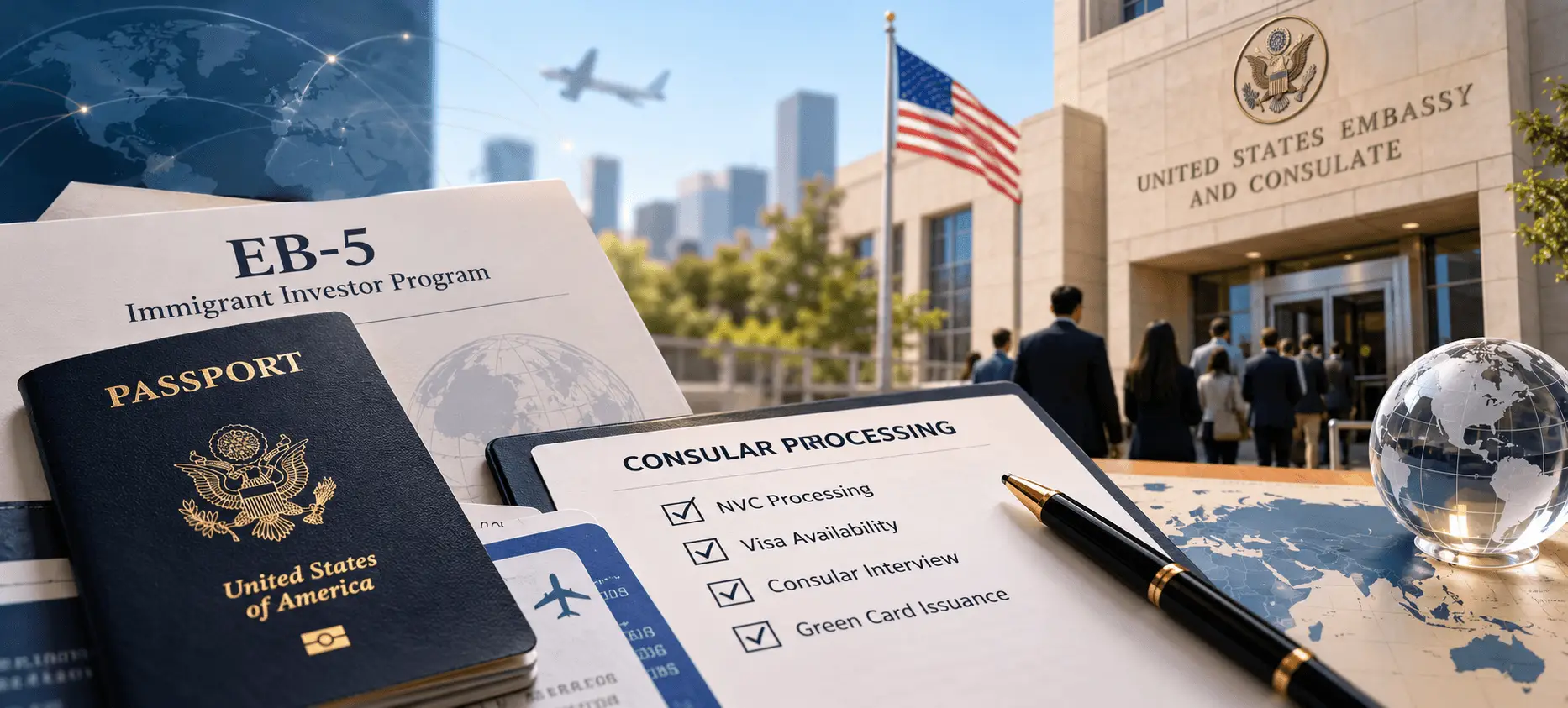
For foreign nationals seeking U.S. permanent residence through the EB-5 Immigrant Investor Program, receiving approval of Form I-526E is an important milestone, but it does not guarantee an immediate green card. Investors completing the process outside of the U.S. must also navigate the National Visa Center (NVC), immigrant visa availability, and an interview at a U.S. embassy or consulate.
Recent EB-5 consular processing developments highlight several issues investors should understand, including differences in interview wait times, restrictions on where applicants may interview, evolving immigration screening policies, and country-specific visa limits. These factors can affect how long investors and their families wait before receiving immigrant visas, even after their EB-5 petitions have been approved.
1. EB-5 Consular Processing Times Vary Significantly by Country
One of the most important trends in EB-5 consular processing is the substantial variation in interview scheduling times among U.S. embassies and consulates. The U.S. Department of State’s Immigrant Visa Scheduling Status Tool provides monthly information about the documentarily complete cases being scheduled at individual posts.
As of October 2026, the published scheduling information shows considerable differences among locations. For example, the employment-based immigrant visa scheduling indicator for Mumbai was April 2026, while Guangzhou’s was August 2023. These dates are general employment-based scheduling indicators, not EB-5-specific wait-time estimates, but they illustrate why investors should investigate the circumstances at their assigned consulate rather than rely on a single nationwide processing estimate.
An applicant’s interview timing depends on several factors, including whether the NVC has received all required documents, whether an immigrant visa is available, and whether the relevant consular post has sufficient capacity to schedule the case. Consequently, two EB-5 investors with similar petition approval dates may experience very different timelines depending on their individual circumstances and interview locations.
2. Investors Generally Cannot Choose Any U.S. Consulate for Their Interview
Another important change concerns where immigrant visa applicants may complete consular processing. Effective November 1, 2025, the Department of State implemented a policy generally directing immigrant visa applicants to the U.S. embassy or consulate serving their country of residence or, upon request, their country of nationality.
This policy limits the ability of applicants to select a third-country consulate simply because it appears to have shorter interview wait times. Exceptions may be available in certain circumstances, including qualifying humanitarian, medical emergency, or foreign policy situations.
The policy is particularly relevant to EB-5 investors who live in a different country from their country of citizenship or who relocate while their immigration cases are pending. Investors should confirm which consular post will handle their cases before making travel plans or estimating the time required to obtain an immigrant visa.
Because transferring an application to another post may not be straightforward, investors should not assume they can avoid a lengthy queue by interviewing in another country. The applicable rules and any exceptions should be confirmed with the Department of State and qualified immigration counsel.
3. Increased Immigration Screening and Vetting May Affect Applicants
Immigration screening and vetting remain important considerations for foreign nationals seeking U.S. visas. In September 2026, the Department of State announced expanded online-presence reviews for certain nonimmigrant visa categories, with additional requirements taking effect October 1, 2026.
The announcement identified categories including H-1B, H-4, F-1, and J-1 visas. However, EB-5 immigrant visa applicants were not specifically identified as a newly covered category under that announcement. Investors should therefore distinguish between screening measures that directly apply to their visa category and broader developments in U.S. immigration policy.
Regardless of any specific new screening requirement, EB-5 applicants should ensure that information provided in their immigration filings is accurate and consistent. Prior visa refusals, immigration status violations, discrepancies in previous applications, or other potential admissibility issues may require careful review before an immigrant visa interview.
4. Public-Charge Policies and Financial Documentation Deserve Attention
Financial circumstances can be relevant to immigrant visa adjudication, particularly when a consular officer considers whether an applicant may be inadmissible under the public-charge provisions of U.S. immigration law.
On August 28, 2026, the Department of State announced that a previously imposed pause on immigrant visa issuance to nationals of 75 countries was no longer in effect as of August 21, following a court order. The Department also stated that it was reviewing screening and vetting policies relating to concerns about public-benefit reliance.
These developments do not mean that every EB-5 investor must post a bond or that making the required EB-5 investment automatically resolves all potential public-charge concerns. The relevance of financial evidence depends on the applicant’s circumstances and the rules applicable at the time of adjudication.
Investors should maintain organized records documenting their personal finances, income, assets, and intended means of support in the United States. They should also preserve the documentation supporting the lawful source and path of their EB-5 investment funds, which remains an important part of the broader immigration process.
If an investor has concerns about admissibility or the application of public-charge rules, an individualized review with experienced immigration counsel may help identify issues that should be addressed before the interview.
5. Country-Specific Restrictions Can Affect Immigrant Visa Issuance
EB-5 investors should understand that interview scheduling and visa issuance are separate stages. An applicant may have an interview scheduled but still encounter a delay or restriction affecting the issuance of the immigrant visa.
In 2026, the Department of State announced several changes to immigrant visa operations and screening policies. Some measures affected applicants based on nationality, while others involved consular operations or broader administrative procedures. These developments demonstrate the importance of monitoring official government announcements rather than assuming that a previously scheduled interview guarantees immediate visa issuance.
Investors should verify the rules applicable to their nationality, country of residence, and assigned consular post before making significant travel or relocation decisions. Where a policy is subject to litigation or subsequent government guidance, its current status should be confirmed rather than inferred from an earlier announcement.
For EB-5 investors, the practical concern is not simply whether an interview can be scheduled, but whether the applicant will be eligible to receive the immigrant visa once the case is adjudicated.
6. EB-5 Visa Availability Remains a Critical Factor for Consular Processing
Even when an EB-5 petition has been approved and the investor’s documents are complete, an immigrant visa must be available before a visa can be issued. Visa availability depends on the investor’s priority date, applicable visa category, and country of chargeability.
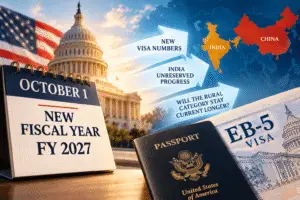
India provides a significant recent example. On June 10, 2026, the Department of State announced that all available FY 2026 EB-5 unreserved visas for applicants chargeable to India had been issued as of June 5. Consular posts could not issue additional visas in that category for the remainder of the fiscal year. The annual visa limits reset when FY 2027 began on October 1, 2026.
This development illustrates how annual visa limits can interrupt consular processing even for investors who have completed other steps in the immigration process. The beginning of a new fiscal year makes additional annual visa numbers available under the applicable rules, but it does not automatically eliminate existing backlogs or guarantee immediate visa issuance.
Investors should also distinguish between the EB-5 unreserved category and the reserved categories established under the EB-5 Reform and Integrity Act of 2022. Rural, high-unemployment-area, and infrastructure investments are associated with separate visaallocations. Availability in one category does not necessarily establish availability in another.
For Indian and Chinese investors in particular, monitoring the monthly Visa Bulletin is essential. Investors should review the applicable EB-5 final action dates and any changes in category availability to understand whether their priority dates permit visa issuance.
The Department of State publishes its monthly Visa Bulletin, which should be reviewed alongside consular scheduling information. The Visa Bulletin addresses visa-number availability, while the scheduling tool indicates which documentarily complete cases are being scheduled at individual posts. Both matter when estimating the remaining time in the EB-5 immigration process.
7. What EB-5 Investors Can Do to Prepare for Consular Processing
Although investors cannot control visa-number allocations, consular staffing, or government policy changes, they can take practical steps to reduce avoidable delays. Completing the DS-260 immigrant visa application accurately, submitting the required civil documents, monitoring NVC communications, and responding promptly to requests for additional information can help prevent administrative problems.
Investors should also confirm the interview procedures at their assigned consulate and ensure that passports, birth certificates, marriage certificates, police certificates where required, and other supporting documents meet the applicable requirements. Information in these documents should be consistent with the investor’s prior immigration filings.
Financial and source-of-funds records should remain accessible, even after Form I-526E approval. Investors should be prepared to answer questions about their investment, immigration history, and personal circumstances. Where prior visa refusals, status violations, or discrepancies exist, they should seek appropriate legal guidance before the interview rather than wait for a problem to arise during adjudication.
Finally, investors should avoid making non-refundable travel arrangements or assuming a specific green-card arrival date until their individual cases have progressed sufficiently to support those decisions.
The above article is for informational purposes only. Anyone with a specific question or situation regarding consular processing should consult with an experienced immigration attorney.