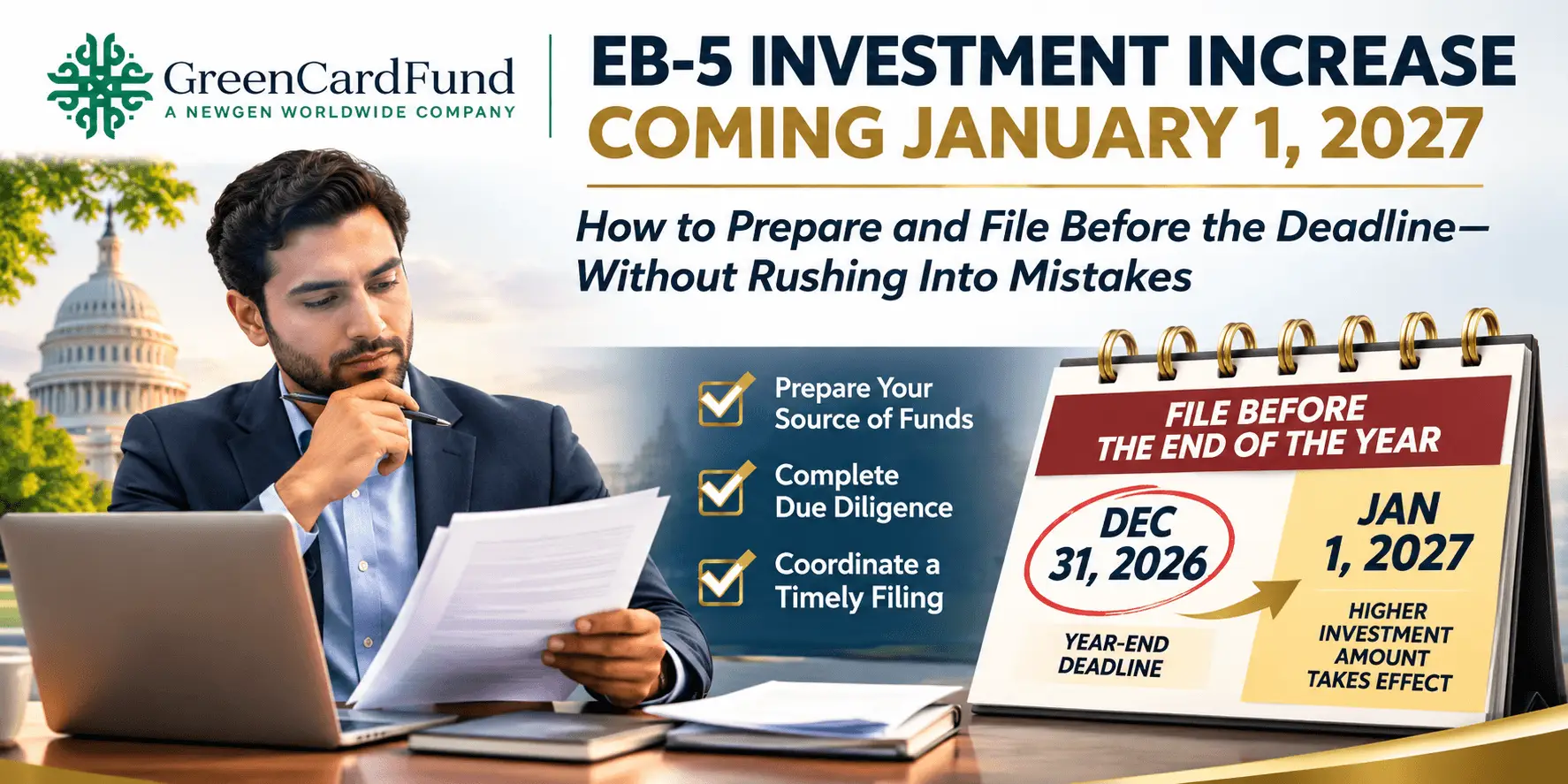
With the EB-5 minimum investment amount scheduled to increase on January 1, 2027, prospective investors are facing an important year-end deadline. For those considering an EB-5 investment, completing the process before the end of 2026 could mean securing the current investment threshold rather than being subject to the higher amount.
However, moving quickly should not mean cutting corners. An EB-5 investment is a significant financial and immigration decision, and mistakes made during the rush to meet a deadline can create complications that last well beyond the initial filing. Investors should approach the remaining weeks of 2026 with a clear plan, prioritize the steps that take the most time, and make sure their immigration and investment documentation is properly prepared.
Here are several practical steps prospective EB-5 investors can take to move efficiently while protecting their interests.
1. Start With an Experienced EB-5 Immigration Attorney
One of the most important decisions an investor can make is selecting experienced EB-5 immigration counsel early in the process. Investors should avoid waiting until they have selected a project or transferred their investment capital before engaging an attorney.
An experienced EB-5 attorney can help evaluate the investor’s eligibility, identify potential source-of-funds complications, establish a realistic filing schedule, and coordinate the preparation of the I-526E petition. This is important for investors whose capital comes from multiple sources, business ownership, property sales, gifts, or loans. These funding arrangements can require substantial documentation and additional legal analysis.
2. Begin Source-of-Funds Preparation Immediately
For many investors, source-of-funds documentation is likely to be the most time-consuming part of the EB-5 process. USCIS requires investors to demonstrate that their investment capital was obtained through lawful means.
Investors should begin collecting financial records as soon as possible. Depending on the source of capital, these may include personal and business tax returns, bank statements, employment records, business ownership documents, property purchase and sale agreements, loan agreements, gift documentation, and records showing the transfer of funds between accounts.
It is important to remember that demonstrating the lawful origin of the money is not necessarily the same as documenting its complete path. For example, an investor using proceeds from a property sale may need to document how the property was originally acquired, establish ownership, demonstrate the source of the original purchase funds, and trace the proceeds through the relevant bank accounts before they reach the EB-5 investment.
3. Choose a Funding Source That Can Be Documented Efficiently
Although investors should never select a funding source solely because it appears easier to document, the availability and quality of financial records should be an important consideration.
For example, accumulated employment earnings supported by tax returns, salary records, and bank statements may be relatively straightforward to document. By contrast, capital derived from complex business transactions, multiple property sales, third-party transfers, or loans secured by assets may require considerably more supporting evidence.
Investors who anticipate using loan proceeds should pay particular attention to the documentation supporting the loan, the lender’s lawful source of funds, the ownership and valuation of collateral, and the investor’s personal repayment obligations. Recent practitioner observations suggest that USCIS has been paying closer attention to these issues in certain I-526E cases.
4. Narrow the Project Selection Process, but Do Not Skip Due Diligence
Selecting an EB-5 project is another decision that can consume considerable time. Investors approaching the January deadline should establish their investment criteria early and focus their research on a manageable number of projects that meet those criteria.
However, the desire to meet the deadline should not lead investors to accept a project without conducting appropriate due diligence. The immigration benefits of EB-5 should not overshadow the financial risks associated with the investment.
Investors should examine the strength and experience of the project sponsor, the underlying business plan, the project’s economic fundamentals, the source and availability of repayment capital, the proposed exit strategy, and the protections available to investors. They should also understand the capital structure, including the relationship between EB-5 financing, developer equity, and any other financing.
A good approach is to create a shortlist of qualified projects, request the offering documents promptly, and have independent legal and financial professionals review the relevant materials. Investors should be prepared to move decisively once they identify an appropriate project, but they should not allow a sponsor’s year-end subscription deadline to replace their own due diligence process.
5. Coordinate the Investment Transfer and Petition Preparation
Once an investor has selected a project, the investment transfer and preparation of the I-526E petition should proceed in parallel whenever possible.
Investors should obtain clear instructions regarding subscription documents, wire transfers, escrow arrangements, and the documentation required to confirm that the investment has been made. They should also coordinate with their attorney to ensure that the investment structure and supporting financial records are consistent with the representations being made in the immigration petition.
One important consideration is that transferring the investment capital is not, by itself, sufficient to secure the current investment threshold. The applicable investment amount is determined by the filing date of the immigrant investor petition under the statutory adjustment framework. Investors should therefore work backward from the filing deadline and make sure the investment, and petition documentation will be ready together.
It is also important to avoid last-minute changes to the investment amount, funding source, or ownership structure. Such changes can require revised documentation and additional legal review, potentially delaying the filing.
6. Do Not Confuse Sending the Petition With Filing the Petition
This is perhaps the most important timing consideration for investors approaching the January 1 deadline.
Under the EB-5 Reform and Integrity Act, the investment amounts are subject to inflation adjustments beginning January 1, 2027, and the adjusted amounts apply to petitions filed on or after the effective date. Consequently, investors seeking to qualify under the current investment thresholds should not assume that initiating a wire transfer, signing subscription documents, or placing a package in the mail before December 31 will be sufficient.
For paper filings, USCIS generally uses the date the petition is physically received at the designated filing location as the filing date, rather than the date the package is shipped. Investors should therefore coordinate closely with their attorneys to ensure that the properly completed petition is received by USCIS before the deadline.
Given the potential for holiday shipping delays, increased filing volume, and administrative complications, investors should establish an internal filing deadline well ahead of December 31. Ideally, the petition should be ready for submission several weeks before the statutory adjustment takes effect.
Investors should also confirm that the correct forms, filing fees, signatures, and supporting documentation are included. A rejected filing can create serious timing problems, particularly when there is little time remaining before the investment threshold changes.
7. Consider Whether Concurrent Filing Is Available
For investors physically present in the United States who qualify, concurrent filing of Form I-
526E and Form I-485 may provide additional benefits. Under the EB-5 Reform and Integrity Act, eligible investors may file their adjustment-of-status applications while their I-526E petitions are pending, provided the applicable visa availability and other requirements are satisfied.
Investors considering this option should discuss it with their immigration attorney early in the process. Preparing an I-485 package alongside the I-526E may require additional documentation, including immigration history, status records, employment information, and medical examination requirements.
Waiting until the I-526E is ready before considering the I-485 can create unnecessary delays. For eligible investors, coordinating both filings from the beginning may provide a more efficient overall strategy.
8. Build a Realistic Timeline With a Buffer
Even with careful preparation, unexpected complications can arise. Banks may require additional time to process international transfers, financial institutions may request additional documentation, and attorneys may need to resolve inconsistencies in financial records or offering documents.
Investors should therefore work backward from the December 31 deadline and establish milestones for each stage of the process. This should include completing the source-of-funds review, selecting the project, executing subscription documents, transferring the investment, finalizing the I-526E petition, and submitting the filing.
Importantly, investors should not plan around the final few days of December. The holiday season introduces additional logistical challenges, and a last-minute filing leaves little room to correct errors or respond to unexpected requests.
A reasonable strategy is to target completion of the investment and petition well before the end of December, leaving sufficient time for final legal review and confirmed delivery to USCIS.
9. Understand What the Deadline Does and Does Not Accomplish
Investors should also understand that meeting the December 31 deadline addresses the applicable investment threshold; it does not guarantee approval of an I-526E petition or eliminate the other requirements of the EB-5 program.
The investor must still demonstrate eligibility, including lawful source and path of funds, a qualifying investment, and compliance with applicable job creation and other program requirements. Similarly, selecting a project in a rural or high-unemployment area does not eliminate the need for appropriate project and investment due diligence.
As of November 2026, the current statutory minimum remains $800,000 for qualifying targeted employment area and infrastructure investments and $1,050,000 for standard investments. The January 2027 adjustment is required by the RIA, but investors should distinguish between projected new amounts and the officially published figures. The exact adjusted amounts should be confirmed through the applicable government publication before making investment decisions.
The above article is intended for informational purposes only. Anyone with questions or looking to file an I-526E petition prior to the January 1 deadline should consult with an experienced immigration attorney.