Recent USCIS policy changes have raised concerns about the potential for more denials of adjustment-of-status applications without an opportunity to correct deficiencies. For EB-5 investors, these developments underscore the importance of submitting complete, well-documented immigration filings from the outset.
Although evidence of an increase in the issuance of more outright denials at this point is anecdotal, the consequences of filing an incomplete or poorly supported application may be more significant under the current policies.
USCIS Gives Officers Greater Discretion to Deny Applications
On August 5, 2026, USCIS issued updated guidance restoring officers’ discretion to deny certain applications without first issuing a Request for Evidence (RFE) or Notice of Intent to Deny (NOID). Previously, applicants could generally expect an opportunity to provide missing initial evidence in circumstances covered by the earlier guidance. Under the revised policy, certain deficiencies may result in a denial without that additional opportunity.
An RFE requests additional evidence to help establish eligibility, while a NOID identifies grounds for a proposed denial and provides an opportunity to respond. Neither has been eliminated. However, applicants should not assume that USCIS will always request missing documentationbefore making an adverse decision.
Separately, a May 2026 USCIS memorandum emphasized the discretionary nature of adjustment of status. This raises additional considerations for applicants whose immigration history includes potential status violations, unauthorized employment or other circumstances that could affect the adjudication of their applications.
What Does This Mean for EB-5 Investors?
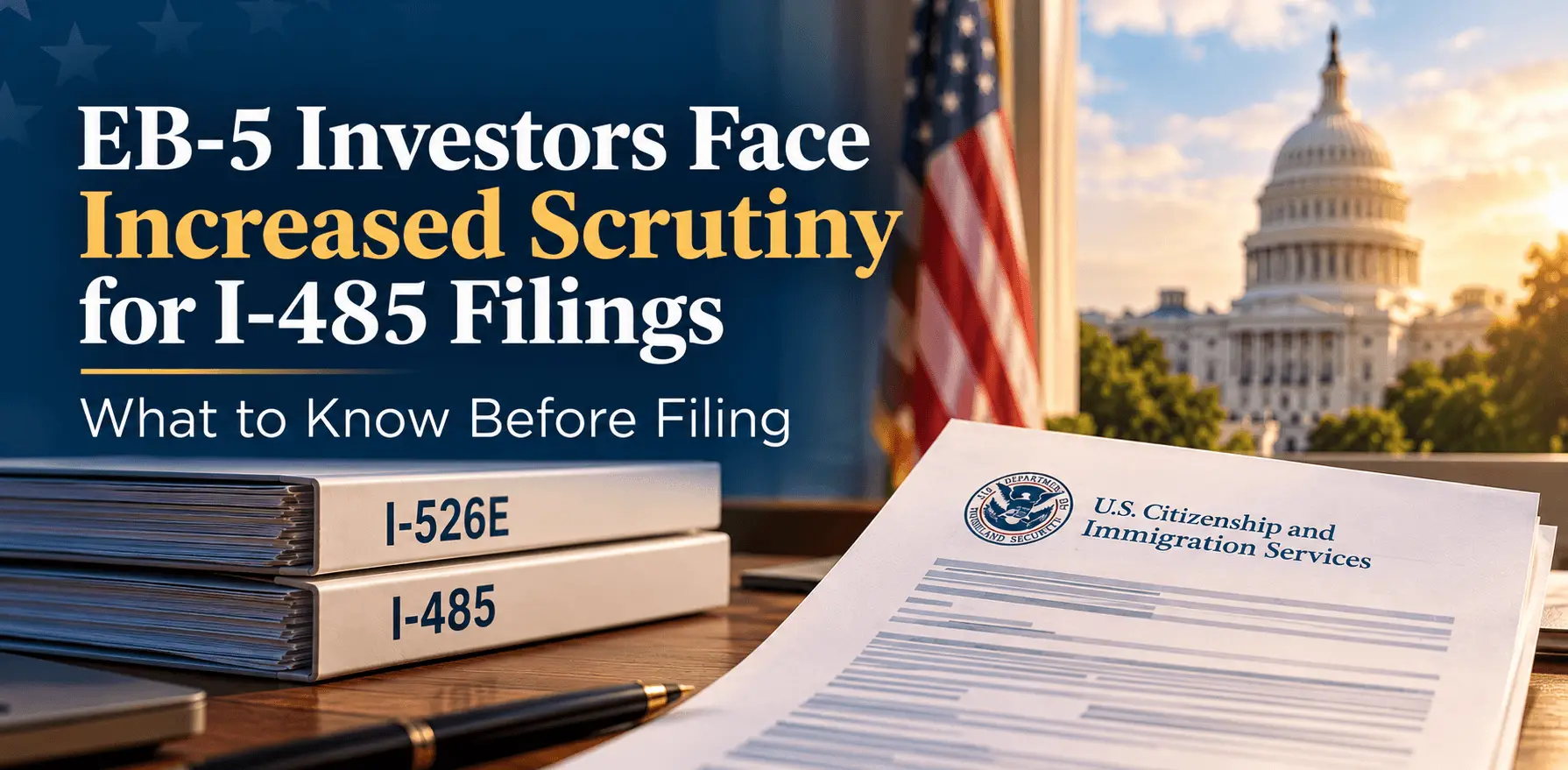
For investors pursuing the EB-5 regional center program, the changes are particularly relevant when preparing Form I-526E, the immigrant petition for regional center investors, and Form I- 485, the application to adjust status to permanent residence.
A properly prepared I-526E should establish that the investment meets EB-5 requirements, including the lawful source and path of the invested funds, the qualifying investment structure, and the applicable job-creation requirements. Investors should work with experienced immigration counsel to ensure that source-of-funds documentation is complete, consistent, and adequately supported before filing.
The I-485 presents a separate set of considerations. Applicants must establish their eligibility to adjust status, including the applicable admission, status, and visa-availability requirements. Incomplete civil documents, missing required evidence, inconsistencies in the immigration history or unresolved eligibility issues can create additional risks. Applicants should also understand that satisfying the statutory eligibility requirements does not necessarily eliminate discretionary considerations under current USCIS guidance.
What Investors Should Know Before Concurrent Filing
The EB-5 Reform and Integrity Act of 2022 (RIA) allows eligible investors in the United States to file Form I-485 concurrently with Form I-526E when an immigrant visa is immediately available.
Concurrent filing can provide earlier access to the adjustment-of-status process, including the ability to apply for employment authorization and advance parole when eligible.
However, concurrent filing does not guarantee faster permanent residence, and it does not eliminate the risks associated with incomplete applications. Investors should confirm their eligibility to file, review the applicable Visa Bulletin and USCIS filing-chart instructions, and ensure that all required initial evidence is included.
Investors should also discuss their existing immigration status with counsel before filing. A pending I-485 does not automatically extend nonimmigrant status or authorize employment. Maintaining an appropriate immigration strategy can be particularly important if adjudication takes longer than expected.
How Investors Can Reduce Filing Risks
The most effective precaution is thorough preparation. Before filing, investors should review the completeness of their source-of-funds documentation, confirm that required forms and supporting evidence are included, and address potential immigration-history issues with counsel. Any inconsistencies between the I-526E, I-485 and supporting documents should be identified and resolved where appropriate before submission.
Investors should also understand the distinction between an incomplete filing and a case that raises substantive eligibility concerns. Strong documentation can help establish eligibility, but it cannot guarantee approval. If USCIS issues an RFE or NOID, the response should address each issue raised within the applicable deadline.
The Bottom Line
USCIS’s updated RFE and NOID policy creates greater risk for applicants who submit incomplete applications, while its adjustment-of-status guidance places additional emphasis on discretionary review. Although a broad increase in EB-5 I-485 denial rates has not yet been established, investors should take these changes seriously.
Before filing Form I-526E and, where eligible, Form I-485 concurrently, prospective investors should prioritize complete documentation, careful eligibility review, and a coordinated immigration strategy. In the current environment, thorough preparation is especially important because applicants may not always receive an opportunity to correct deficiencies before USCIS makes a decision.
The above article is for educational purposes only, and investors should consult qualified immigration counsel regarding their individual circumstances.